Four years from now, 24 senior officials who owe their mandate to Fidesz could still be in their positions
Following the national elections in Hungary in April, a host of public office holders who are difficult to remove remained in their positions, owing their appointments solely to the previous government or the former Fidesz parliamentary majority. The Hungarian Helsinki Committee prepared an infographic showing how long they could remain in office if nothing changes.
Translation is available for this content
Váltás magyarraIt is of fundamental importance for our daily lives and our shared future who Hungary’s most important public officials are, and who heads the independent constitutional institutions that are supposed to operate as checks and balances on power. It is also of fundamental importance for the rule of law in Hungary how public officials, from the President of the Republic to the President of the National Election Commission, for example, are appointed to their posts.
Over the past 16 years, we experienced how meaningless it is that institutions are independent on paper if they are run solely by individuals loyal to those in power. Today, all of our senior public officials are like this. They have been reliable pillars of an electoral autocracy, playing an inglorious role in the dismantling of the rule of law and democracy. That is why the former governing party Fidesz has cemented them to their current positions for lengthy terms.
To understand why it is alleged that those appointed or elected in this manner will use the formal and informal tools associated with their positions to obstruct the new government, it is worth reviewing exactly what their duties are, what the institutions they lead do, and how long their terms last. Such officials are present in every corner of the state apparatus.
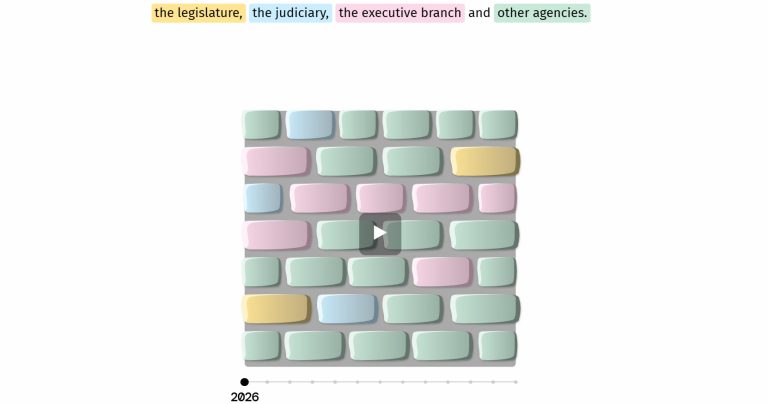
➡️ cementezettek.helsinki.hu/en ⬅️
The Hungarian Helsinki Committee originally created the Cemented website before the 2022 elections, which it has now updated. This shows that as things stand, of the 33 most important leading officials, provided they fill out their terms, 32 could still be in their positions two years from now, and 16 could still be there five years from now. In fact, seven of the top officials appointed or elected during the electoral autocracy could still be in their positions as late as 2035. Péter Polt, the current president of the Constitutional Court, holds a mandate that runs until 7 June 2037, when he will be 82 years old.
Among those appointed for a fixed term, Constitutional Court justice Ákos Kozma has the longest remaining term, which could last until 25 September 2037. Yet he has already failed in his role as Commissioner for Fundamental Rights (as Ombudsperson), and due to his glaring passivity, the Hungarian ombudsperson system, which could play a key role in the institutional protection of citizens’ rights, has been downgraded. His example also shows that the “cemented” officials did not get their seats because of professional competence, a commitment to serving the rule of law, or a commitment to checking on power, but were cemented into their positions because of their unconditional loyalty to those in power.
In a constitutional democracy, the system of checks and balances is of paramount importance; it makes the system of separation of powers viable, fills it with substance, and prevents the acquisition and exercise of absolute power.
Yesterday, Prime Minister Péter Magyar announced that he intends to remove the President of the Republic, Tamás Sulyok through an amendment to the Fundamental Law, Hungary’s constitution. The text of the proposal is not yet public, but a few things can already be stated with certainty.
The transformation of the constitutional system is a pivotal moment in restoring the rule of law and ensuring Hungary’s democratic functioning. The constitutional majority in the legislature must make difficult decisions – in some cases, unprecedented ones. Moreover, the constitution is the fundamental document of the entire political community, belonging to the opposition just as much as to the ruling party. For all these reasons, and in accordance with relevant international standards, it is certain that broad social consultation is necessary in this process, no matter how tight the schedule may be. While simply replacing senior public officials might make it easier to exercise power in the short term, in the long run it would serve the stability of constitutional democracy if strong guarantees were also put in place to ensure that the selection of new officials truly serves the independence of constitutional institutions.
The Hungarian Helsinki Committee has been working since the elections to explore related public law options. The civil society organisation is examining the domestic and international legal framework and best practices regarding the removal of certain public officials, as well as how constitutional mechanisms can be used to establish personal safeguards for the system of checks and balances. Because what the country truly needs are not cemented-in, set-in-stone puppet figures who pose a threat to democratic functioning, but public officials committed to a Hungarian state based on the rule of law.
The world is changing. Our devotion to human rights remains the same.
Please donate to the Hungarian Helsinki Committee, so that we can continue to stand up for human dignity and offer professional legal help to those who need it most.