Hungary’s Democratic Transition Faces a Structural Obstacle: 33 Senior Officials Entrenched for Years to Come
The Hungarian Helsinki Committee has updated its Cemented website to document how long Fidesz-appointed officeholders can remain in their posts.
Translation is available for this content
Váltás magyarraFollowing Hungary’s April elections, a new government has taken office. But winning an election is not the same as controlling the state. Across Hungary’s institutions — the bodies designed to check and balance executive power — sit 33 senior officials who owe their positions not to the new parliamentary majority, but to 16 years of Fidesz rule.
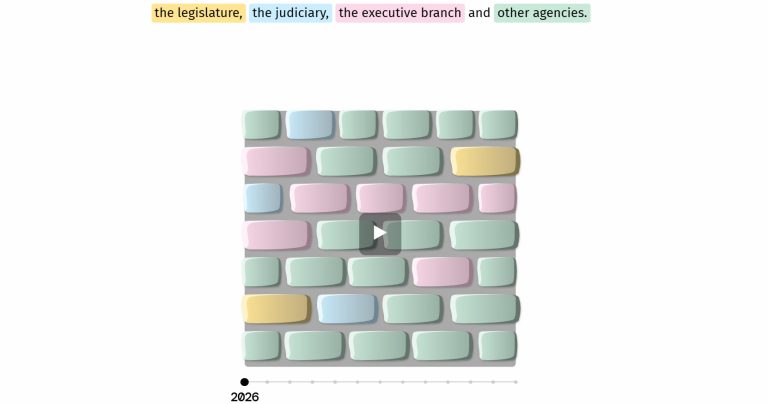
➡️ cementezettek.helsinki.hu/en ⬅️
The Hungarian Helsinki Committee has now updated its Cemented website, originally launched before the 2022 elections, to reflect the current picture. The findings are sobering: of the 33 most important senior officials, 32 could still be in their positions two years from now, and 16 could remain in place five years from now, provided they serve out their terms. Seven officeholders appointed or elected during the Fidesz era could still be sitting in their posts as late as 2035.
Several mandates belong to figures already controversial for their role in dismantling Hungary’s rule-of-law framework. For example, Péter Polt, the former Prosecutor General, currently president of the Constitutional Court, holds a mandate running until 7 June 2037 — at which point he will be 82 years old. Constitutional Court justice Ákos Kozma holds the longest remaining individual term, expiring 25 September 2037. Kozma’s case is particularly illustrative: previously serving as Commissioner for Fundamental Rights, his tenure as Ombudsperson was marked by such glaring passivity that Hungary’s ombudsperson system — an institution that should serve as a frontline defender of citizens’ rights — was downgraded. His appointment, like others, reflected not professional competence or commitment to the rule of law, but unconditional loyalty to those in power.
This pattern was not accidental. Over 16 years, Fidesz methodically placed loyalists into every corner of the state apparatus and secured their positions with lengthy fixed terms. The result was institutions that were independent on paper and captured in practice — reliable pillars of an electoral autocracy. Understanding why this matters requires looking at what these officials actually do. They head the institutions responsible for constitutional review, electoral oversight, fundamental rights protection, and more. Their formal and informal powers give them significant capacity to obstruct a new government, even one with a strong parliamentary mandate.
Who holds these positions — and how they came to hold them — is not an abstract question of constitutional architecture. It shapes the daily functioning of the state and the lived experience of democratic life.
Prime Minister Péter Magyar has now announced his intention to remove President of the Republic Tamás Sulyok through an amendment to Hungary’s Fundamental Law. The text of the proposal has not yet been made public.
When embarking upon transforming Hungary’s constitutional system, the legislature’s constitutional majority will face difficult, in some cases unprecedented, decisions. However, Hungary’s constitution belongs to the whole political community, not only to those currently in government. For that reason, and in line with relevant international standards, broad public consultation is essential, however compressed the timeline. Simply swapping out senior officials may ease the exercise of power in the short term while storing up problems for the long term. What is needed alongside personnel changes are strong institutional guarantees: mechanisms that ensure future appointments to independent constitutional bodies are made in a way that ensures the institutions’ true independence.
Since the elections, the Hungarian Helsinki Committee has been working systematically to map the legal landscape. The organisation is examining domestic and international legal frameworks governing the removal of senior officials, reviewing best practices from comparable situations, and analysing how constitutional mechanisms can be used to build durable safeguards into the system of checks and balances.
The goal is clear: not to replace one set of entrenched figures with another, but to help build a Hungarian state where constitutional institutions are run by officials genuinely committed to the rule of law — and where no future government can so easily cement its loyalists into place.
The world is changing. Our devotion to human rights remains the same.
Please donate to the Hungarian Helsinki Committee, so that we can continue to stand up for human dignity and offer professional legal help to those who need it most.