
RED-SPINEL – Responding to Emerging Dissensus. SuPranational Instruments and Norms of European Democracy (2022-2025)
Translation is available for this content
Váltás magyarraSince September 2022, the Hungarian Helsinki Committee has been involved in the RED-SPINEL research project, funded by the Horizon Europe Programme of the European Commission and coordinated by IEE-ULB.
Over a period of 36 months, RED-SPINEL aims at analysing the illiberal contestation over liberal democracy and identifying the actors of dissensus surrounding democracy as well as its impact on the EU’s legal and political system. The project strives to facilitate democratic practices by developing policy recommendations and a clearer understanding of the political and ideological debates concerning democracy.
The academic institutions and civil organisations involved in RED-SPINEL will focus their research on key policy instruments and legal mechanisms shaping the EU’s efforts in support of democracy and the rule of law. The studied instruments include the EU rule of law toolbox, the neighbourhood and accession instruments, the European semester, fundamental rights and judicial instruments, as well as citizen participation platforms.
The project involves 11 partner organisations representing academia as well as civil society from 8 European countries:
- Université libre de Bruxelles (Belgium),
- Libera Università Internazionale degli Studi Sociali Guido Carli (Italy),
- Universiteit van Amsterdam (Netherlands),
- Universitatea Babeș-Bolyai (Romania),
- HEC Paris (France),
- Uniwersytet Mikołaja Kopernika w Toruniu (Poland),
- University of Warwick (United Kingdom),
- PATRIR (Romania),
- Milieu Consulting (Belgium),
- Hungarian Helsinki Committee (Hungary)
- Stichting Nederlands Instituut voor Internationale Betrekkingen Clingendael (Netherlands).
Key Outputs Prepared by the Hungarian Helsinki Committee
Policy brief
Strengths and Weaknesses of EU Conditionality Regimes: The Case of Hungary
This policy brief reflects on the evolution of EU conditionality regimes linked to the 2021–2027 Multiannual Financial Framework and the Recovery and Resilience Facility. Drawing on Hungary’s experience, it analyses the effectiveness of these tools in addressing rule of law concerns and offers concrete policy recommendations to strengthen democratic accountability and ensure that EU funds uphold common values.
Podcast
Making Sense of EU – The Threats Weighing on Academic Freedom in Hungary Today
In this episode of Red Spinel’s Podcast Series, András Léderer from the Hungarian Helsinki Committee discusses the transformation of Hungarian higher education institutions into privately owned entities managed by government-appointed boards with lifelong tenure. The conversation explores how these foundations, endowed with significant public assets, impact academic freedom, institutional autonomy, and public accountability. The episode also features Orsolya Vincze (K-Monitor) and Gergely Kovács (Corvinus University of Budapest), who share insights on the political motivations, governance challenges, and long-term implications of this model for academic freedom and the integrity of Hungary’s higher education system.

Podcast
Making Sense of EU – Civil Society Monitoring of EU Funds in Hungary and Poland
In this episode, Anna Gelencsér from the Hungarian Helsinki Committee speaks with Anna Grudzinska (National Federation of Polish NGOs, OFOP) and András Léderer (HHC) about the role of civil society in monitoring EU funds. The discussion explores shared and country-specific challenges from bureaucratic hurdles to political hostility and highlights good practices such as joint advocacy and on-site monitoring. The guests also outline how training, sustainable funding, and adherence to the EU partnership principle could strengthen civil society participation in EU fund oversight.
Handbook for Civil Society Organisations
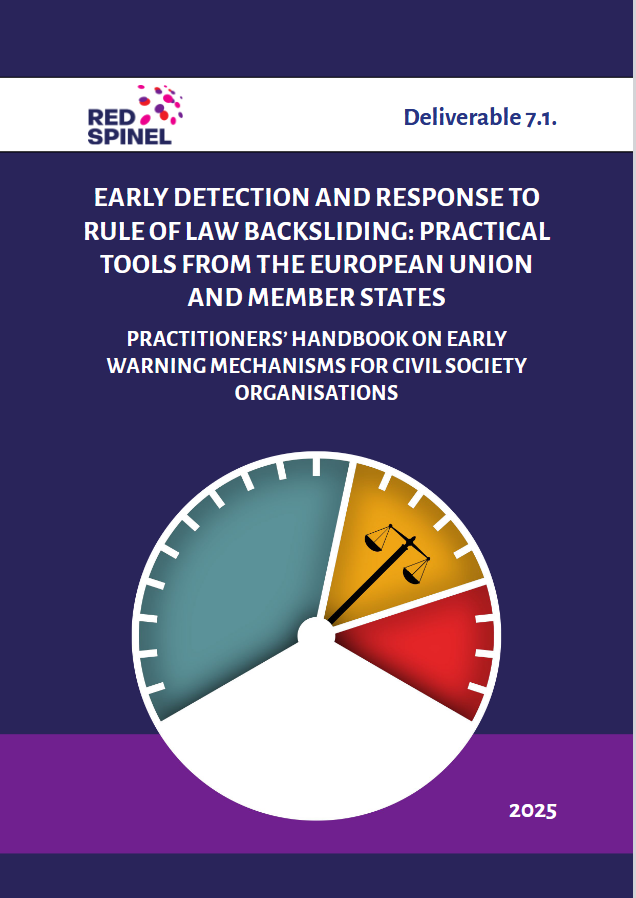
Practitioners’ Handbook on Early Warning Mechanisms for Civil Society Organisations
This practical guide, prepared by the Hungarian Helsinki Committee, maps existing early warning mechanisms that help detect and respond to rule of law backsliding before it becomes systemic. It covers both EU-level instruments (such as the Rule of Law Report, EU Justice Scoreboard, and Article 7 TEU) and national-level practices from Belgium, Hungary, the Netherlands, and Poland. The Handbook offers actionable insights for CSOs to use these mechanisms effectively in advocacy, monitoring, and early intervention.
Training Resources for European Legal Practitioners
Focusing on the EU Charter of Fundamental Rights as a Litigation Tool
The training material, prepared by the Hungarian Helsinki Committee, helps legal practitioners make strategic use of the EU Charter of Fundamental Rights in national and European litigation. They outline how to frame Charter-based arguments, navigate admissibility rules, and integrate strategic litigation into broader advocacy. The document includes thematic sections on rule of law, climate, media freedom, and equality, complemented by a case law database to guide practitioners seeking systemic rights protection.
Study on Innovative Practices of Civil Society Regarding the EU Rule of Law Toolbox
From Principle to Practice: Cultivating a Rule of Law Culture in Europe
This study explores how CSOs across the EU are developing practical and innovative methods to strengthen the rule of law, engage effectively with the EU’s rule of law toolbox, and cultivate a broader rule of law culture. Drawing on the HHC’s own survey, interviews and desk research, the report highlights real-life practices such as early-warning systems, joint contributions to the EU Rule of Law Report, strategic use of the EU Charter of Fundamental Rights, enhanced digital security and storytelling tools that make rule of law issues accessible to the public. The findings offer actionable insights for CSOs working to reinforce democratic resilience across Europe.

For more information, please visit the project website here.

 This project receives funding from the European Union’s Horizon Europe research and innovation programme under the Call HORIZON-CL2-2021-DEMOCRACY-01 – Grant agreement no. 101061621.