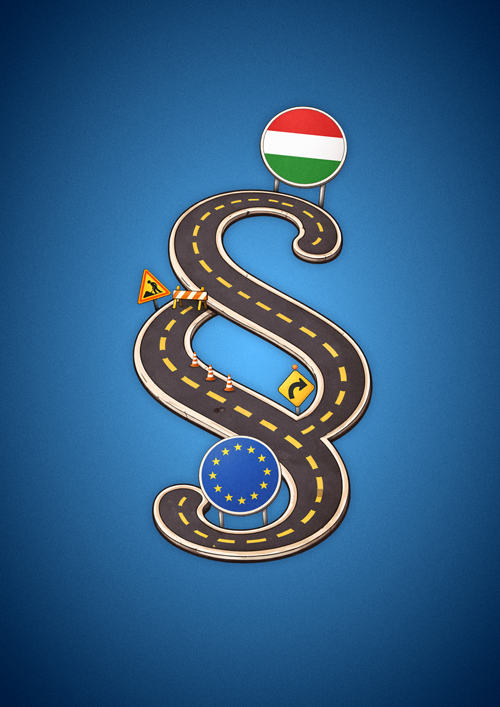
Hungarian CSOs contribute to the European Commission’s 2026 Rule of Law Report
For the seventh year in a row, the Hungarian Helsinki Committee is contributing to the European Commission’s annual Rule of Law Report in coordination with other Hungarian human rights and anti-corruption CSOs in the framework of the stakeholder consultation launched by the European Commission.
Once again, Amnesty International Hungary, the Hungarian Civil Liberties Union, the Hungarian Helsinki Committee, K-Monitor, Mertek Media Monitor, Ökotárs – Hungarian Environmental Partnership Foundation, Political Capital, and Transparency International Hungary teamed up to provide an overarching assessment of the rule of law situation in Hungary.
The compilation of the contributions of the above civil society organisations to the 2026 Rule of Law Report covers all four pillars of the Rule of Law Report: the justice system, the anti-corruption framework, media pluralism and media freedom, and other institutional issues related to the system of checks and balances. The contributions shows that the Hungarian authorities have not implemented any of the recommendations put forth by the European Commission’s Rule of Law Report in 2025, and in certain areas the situation has deteriorated even further.
Key deficiencies include but are not restricted to the following:
- Despite amending justice-related laws once again in 2025, no measures were introduced to improve the transparency of case allocation systems at lower instance courts or tackled the systemic deficiencies related to judicial remunerations. Judges speaking out in defence of judicial independence continue to face pressures, and Hungary’s top court aims to use domestic procedures to block the direct effect of EU law.
- In the field of anti-corruption, Hungary failed to advance on repeated recommendations to put forward comprehensive reforms on lobbying and revolving doors and to improve the system of asset declarations. Authorities continue to lack a robust track record in investigating and prosecuting high-level corruption: for example, the most significant corruption case in 2025, the alleged misappropriation of public funds linked to the Central Bank’s former leadership, has seen limited investigative progress and no meaningful asset recovery efforts.
- Media freedom remains under significant pressure. Hungary has not implemented the European Media Freedom Act, prompting an infringement procedure by the European Commission. The independence of the media regulatory authority has not been enhanced, state advertising continues to distort the media market, and the public service media’s governance and editorial independence has not been strengthened. The freedom of information framework continues to hinder access to public interest information.
- The situation of civil society has further deteriorated. Rather than removing obstacles, a new law was proposed that could enable blacklisting, funding bans, and ultimately the dissolution of civil society organisations and media outlets. Together with intensified hostile political rhetoric and stigmatisation, this has created a chilling effect on civic participation. Constitutional and legislative changes led to the banning of Pride events, with organisers facing criminal charges. Institutional checks and balances remain weak, while the law-making process lacks transparency and inclusivity.
In sum, the lack of progress and new developments show continued and severe disrespect for EU values, EU law, and the judgments of the Court of Justice of the European Union.
➡️ The compilation of the contributions of the eight civil society organisations above on the rule of law in Hungary is available here:
Contributions of Hungarian CSOs to the European Commission’s Rule of Law Report (January 2026)
Hungarian CSO contributions to earlier Rule of Law Reports are available here:
2020, 2021, 2022, 2023, 2024, 2025.